 Busimy
Couples finances: how to organize money between two
What works best for couples finances is keeping three things apart: what's yours, what's ours, and how ours is split. Record shared expenses as they happen, pick a split rule (half and half, a fixed percentage or by what each one earns) and settle the difference every so often. An app like Busimy does that math for you.
Yours, mine and ours
You don't need to pool all your money in one account to keep couple finances in order. A mixed model is usually healthiest: each person handles personal spending (clothes, their own outings, personal savings) and household costs are kept in common.
What matters is that both see the same thing: what was spent on the home, who paid it and how much each one puts in. When that lives in a spreadsheet only one person updates, arguments follow.
Three ways to split household costs
- Half and half: simple and fair when both earn about the same.
- Fixed percentage: for example 60 / 40, if you agree one puts in more.
- By income: each pays in proportion to what they earn. If one earns twice as much, they put in twice as much.
An example with numbers
Anna earns $6,000 and Ben $4,000 a month. Together they earn $10,000, so Anna covers 60% and Ben 40% of household costs.
If this month they pay $2,000 of rent (Anna paid it) and $1,000 of groceries (Ben paid it), the total is $3,000. Anna’s share is $1,800 and Ben’s $1,200. Anna already paid $2,000 and Ben $1,000: Ben owes Anna $200 to be even.
How Busimy does it
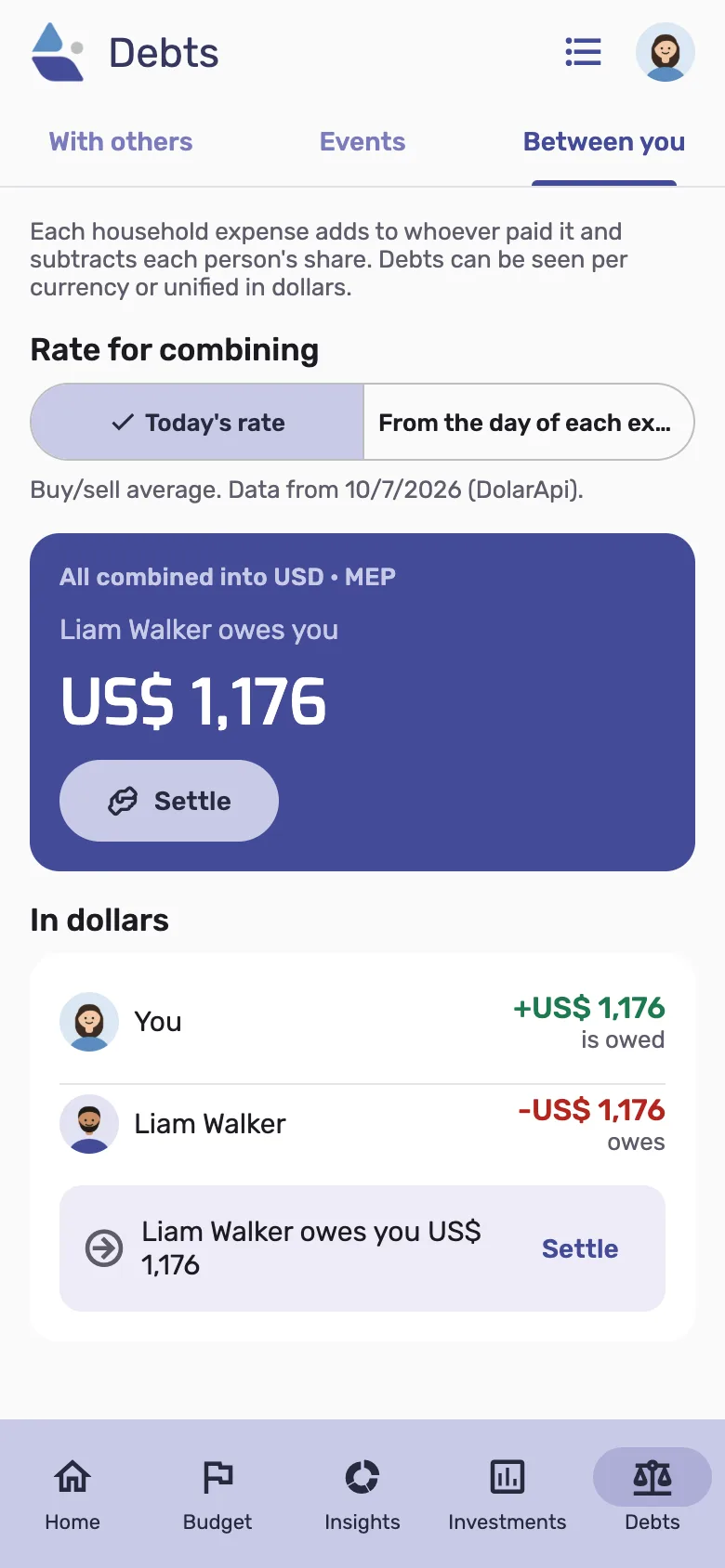
In Busimy you create a household, invite your partner by email and choose how it's split: equally, by percentage or by income. Every expense is recorded with who paid it, and the app instantly works out who owes whom.
Personal stays personal: your private expenses are only visible to you. And if you earn or save in more than one currency, each currency keeps its own balance, with no made-up conversions.
How to start, step by step
- List the household fixed costs: rent or mortgage, utilities, internet, groceries, insurance, school.
- Decide what's shared and what's personal. A useful rule: what you both use is shared; what each one chooses for themselves, personal.
- Choose how to split the shared part: half, a fixed percentage or by income. You can change it when your situation changes.
- Record each shared expense when it happens, with who paid it. If you leave it for the end of the month, things get forgotten.
- Once a month, look at the balance: who owes whom and how much. Settle it with a transfer and start from zero.
Common mistakes
- Keeping track from memory: it always feels like one puts in more than they do.
- Splitting half and half when incomes are very different: the one who earns less is left with little, and resentment shows up.
- Mixing everything in one account with no record: later nobody knows where the money went.
- Not talking about personal spending: you don't need to control it, but you do need to agree each one pays their own.
- Waiting months to settle up: the bigger the debt between you, the harder it is to bring up.
Shared savings and goals
Besides day-to-day costs, many couples have shared goals: a holiday, moving, a car. It works well when each one contributes to that goal with the same rule they use for expenses (if you split by income, save by income too).
If you also invest, keep it in the same place: you see both your net worth without pooling everything into one account.
Frequently asked questions
- Should we have a joint account?
- It isn't necessary. Many couples keep their own accounts and track shared costs in an app; what matters is seeing the same numbers and settling the difference now and then.
- What if one earns much more than the other?
- Splitting by income is usually fairest: each puts in the same share of what they earn, not the same amount.
- Is Busimy free?
- Yes, you can use it for free in the browser, on your computer or phone.
- How often should a couple settle up?
- Once a month is enough for most. If amounts are large or one of you has little cash on hand, every two weeks. What matters is that it is a routine, not an argument.
- What if one of us doesn't work or has an irregular income?
- You can split by what comes in each month, or agree on a fixed contribution. What matters is that the rule is agreed and you both see the same numbers.