 Busimy
Pay yourself first: the saving habit that actually works
"Pay yourself first" means setting aside savings as soon as you get paid, before paying anything else, instead of saving what's left at the end of the month. It works because saving stops depending on willpower: what isn't in your spending account doesn't get spent.
Why "whatever's left" doesn't work
Spending adjusts to the money available: with more in the account, you spend more without noticing. That's why there's rarely anything left at the end of the month, even after a raise.
How much to set aside
On a $3,000 monthly income, 10% is $300 a month: $3,600 in a year before any interest.
| Situation | To start | Goal |
|---|---|---|
| With expensive debt | 5% | A minimal emergency fund, then the debt |
| No debt, no emergency fund | 10% | Save 3 to 6 months of fixed costs |
| With an emergency fund | 15% to 20% | Invest for the long term |
How to automate it
- Open a separate account just for savings, different from the one you pay from.
- Schedule an automatic transfer on the day you get paid.
- Start with a percentage that doesn't hurt; raise it a point every time your income goes up.
- Don't touch it except for what it's for.
What if I can't make it to the end of the month
If you can't make it after setting savings aside, the problem is spending, not saving: it's the signal to review where the money goes. Lowering the percentage for a while is fine; dropping it to zero isn't.
How Busimy does it
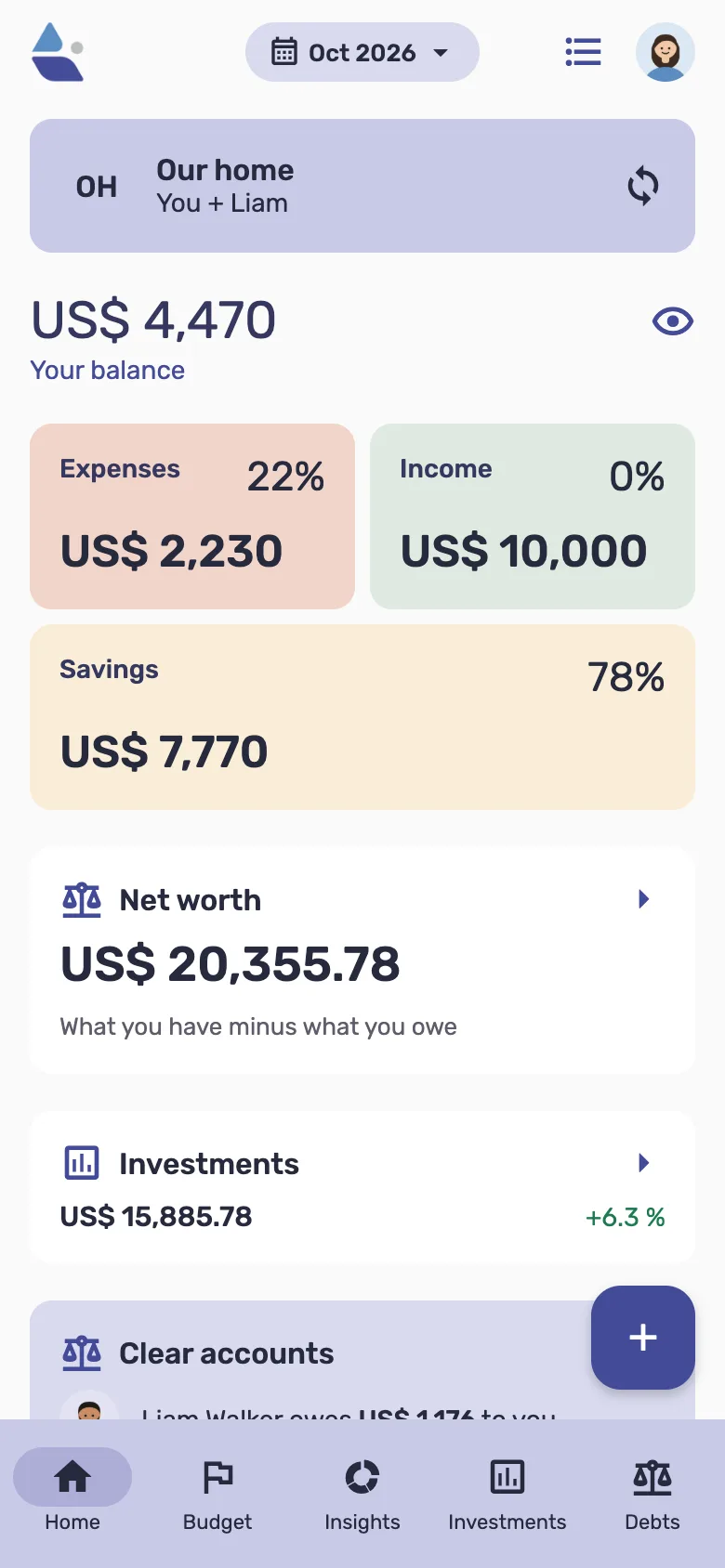
In Busimy you see each month how much you really saved (income minus spending) and your savings accounts separately, in each currency. That way you know whether the percentage you set aside holds up.
Frequently asked questions
- Where does the phrase come from?
- It was popularized by George S. Clason's 1926 book "The Richest Man in Babylon", and many personal finance books picked it up later.
- Is it the same as the 50/30/20 rule?
- They complement each other: the rule says how much to save (20%) and "pay yourself first" says when (as soon as you get paid).
- What if my income is irregular?
- Set aside a percentage of each payment instead of a fixed monthly amount: savings then rise and fall with what comes in.